 Atalanta
Mobile, web and API tests in YAML, from one static binary.





Docs · How it works · Example · FAQ · Status · Changelog
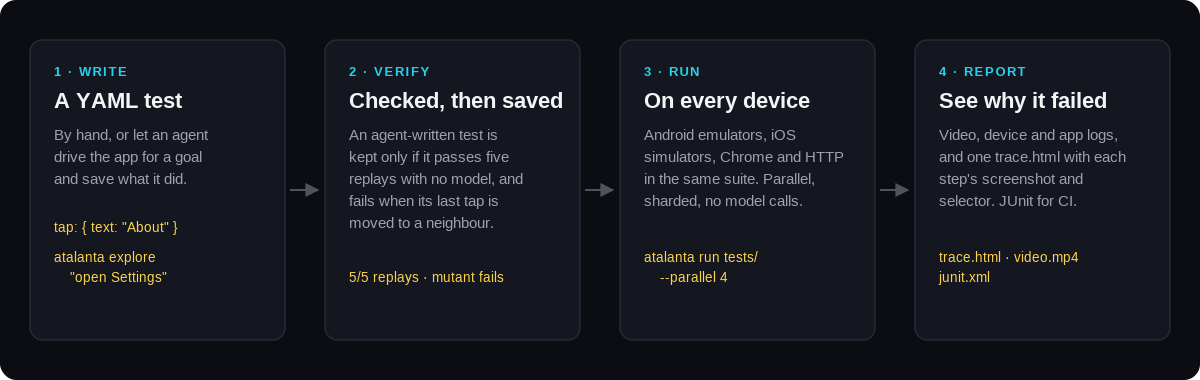
Atalanta runs test suites on Android emulators, iOS simulators and Chrome. It is written in Rust: no JVM, no Node, no Appium server. Write the tests in YAML, or let an AI agent drive your app and write them for you. An agent-written test is checked before it is saved, and a saved test replays in CI without calling a model.
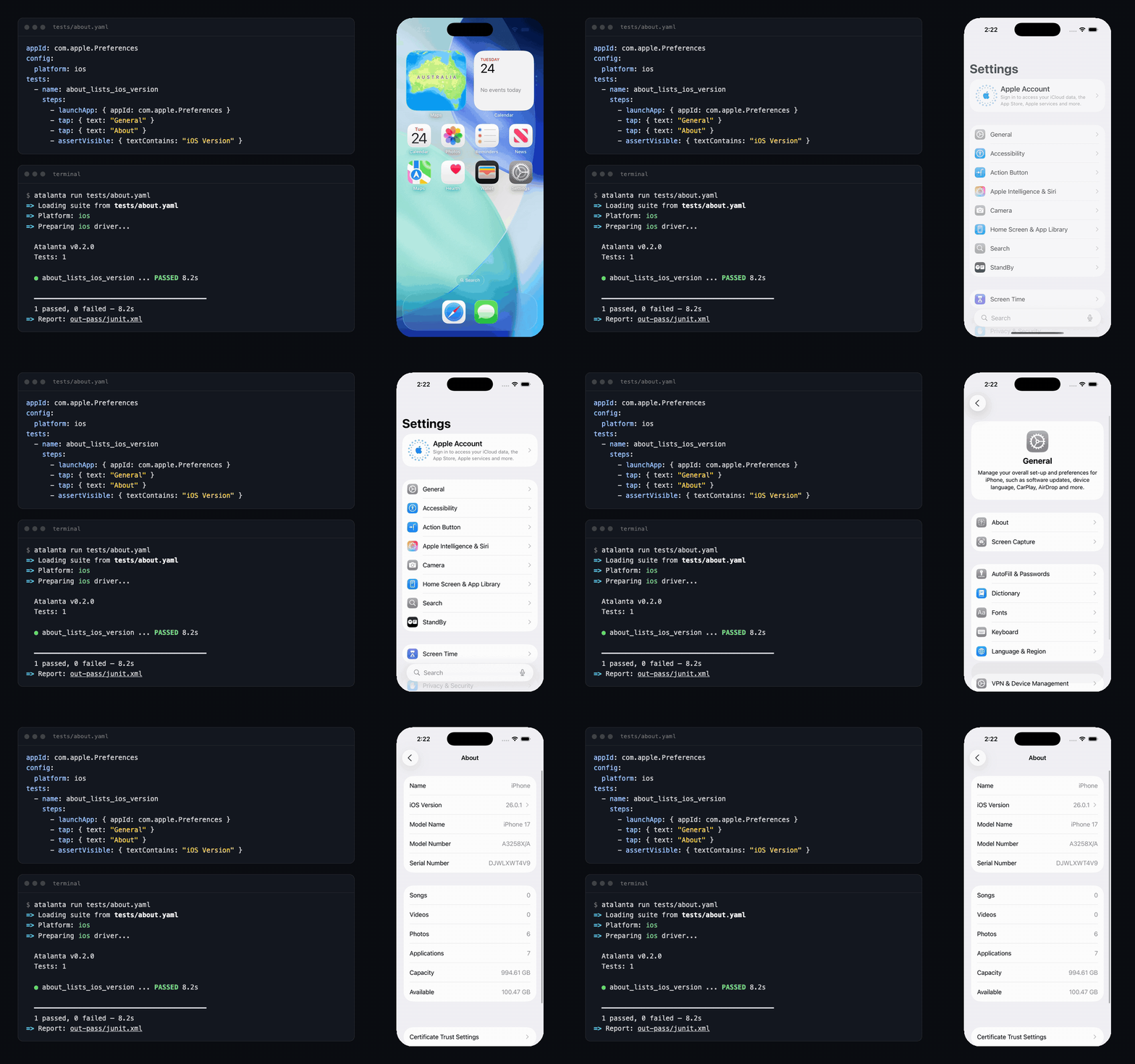
A real run on an iOS 26 simulator. The phone is the video Atalanta recorded of the test.
The latest release is 0.2.0. docs/STATUS.md lists what has been verified, and on which devices.
What it does#
- No sleeps. Every step waits for its element and for the screen to settle.
- Agent-written tests.
atalanta explore "<goal>"drives the app and saves the session as a YAML test. - Checked before saving. An agent-written test is kept only if it passes five replays with no model and fails when its last tap is moved to a neighbouring element.
- No model in CI. The model picks an operation and an element number; code builds every selector and fills every value. Saved tests make no model calls.
- APIs in the same suite. An
httpstep checks the response and captures values for later UI steps. - Evidence on your machine. A failed test keeps a video, the device and app logs, and one
trace.html. No cloud account. - A local console. It mirrors every device and browser, shows the selector under the cursor, and runs suites and agent sessions.
- Agent tooling. Agents drive devices through an MCP server or plain shell commands.
- Fast CI. Run in parallel across devices, shard by past durations, or run only the tests a change can affect.
- Your model. Use any of 19 AI providers, local models included.
| Platform | Driven with | Requires | Verified on |
|---|---|---|---|
| Android | adb and Atalanta's on-device UI server | Android SDK platform-tools | 100+ devices (emulators API 33–34; physical phones and tablets through Android 14) |
| iOS | WebDriverAgent or Atalanta's own XCUITest runner | macOS with Xcode | iOS 26 simulators; multiple iPhones (12 and later) |
| Web | Chrome DevTools Protocol | Chrome or Chromium | Headless Chrome on macOS and Linux |
| API | HTTP | Nothing |
Quick start#
Install on macOS or Linux:
brew install atalantahq/tap/atalanta
# or
curl -fsSL https://atalanta.sh/install.sh | sh
Or build from a checkout: cargo install --path atalanta-cli --locked.
To try the YAML first, the playground checks a suite in your browser and runs API tests there.
Start an emulator or simulator with your app installed, then:
atalanta doctor          # checks adb, Xcode, devices, Chrome and AI keys; --fix applies the safe fixes
atalanta init --run      # writes a first test from the app's launch screen and runs it
atalanta explore "open Network & internet" --app-id com.android.settings   # an agent writes a test
atalanta run open-network-internet.yaml                                    # replays it, no model
In CI:
atalanta run tests/ --parallel 4 --report junit,github --retries 1
atalanta run tests/ --shard 2/4 --shard-timings history/
atalanta run tests/ --changed-since origin/main
atalanta init also writes a sharded GitHub Actions example to atalanta/ci/. See docs/CI.md.
Install#
Every route installs the same binary:
curl -fsSL https://atalanta.sh/install.sh | sh   # macOS / Linux
brew install atalantahq/tap/atalanta
npm install --save-dev @atalantahq/cli
cargo install atalanta-cli --locked
The first iOS run builds WebDriverAgent, which takes about a minute once per Xcode version. Signing, checksums and attestations are under Install details.
How it works#
Example#
appId: com.example.app
tests:
  - name: Log in and open an order
    steps:
      - launchApp: { clearState: true }
      - inputText: { selector: { id: email }, text: "qa@example.com" }
      - inputText: { selector: { id: password }, text: "${LOGIN_PASSWORD}" }
      - tap: { id: login_button }
      - assertVisible: { text: "Welcome" }
      - do: "open the first order"          # natural language, cached once verified
      - http:
          method: GET
          url: https://api.example.com/orders/latest
          expect: { status: 200 }
          capture: { ORDER_ID: id }
      - assertVisible: { text: "${ORDER_ID}" }
Secrets are typed by name (${LOGIN_PASSWORD}) and masked in every report, log and trace. The full format is in docs/DSL.md, and examples/ has suites you can run as they are: Android, web, API only, and API plus web.
When a test fails#
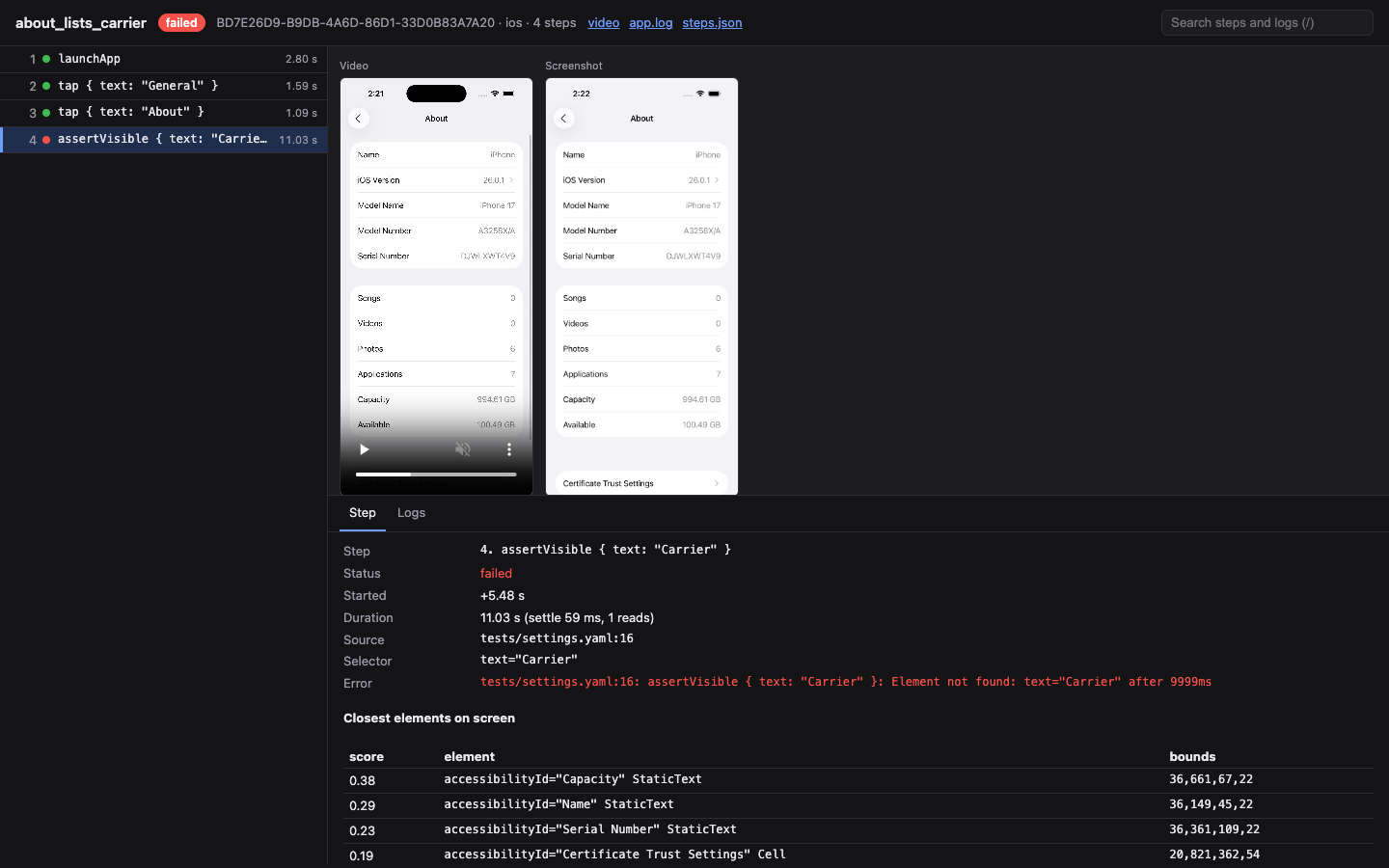
● about_lists_carrier ... FAILED 17.3s
  └ tests/settings.yaml:16: assertVisible { text: "Carrier" }: Element not found: text="Carrier" after 9999ms
Each failed test gets a trace.html: the steps with their timings, the video, the screen at the failing step, the selector and the closest elements that were on screen.
Console and agents#
atalanta inspect --open   # the console
atalanta mcp install      # registers the MCP server with your coding agents
The console is one browser page for every booted device and the web browser: a live mirror you can click and type on, an element overlay that shows the selector Atalanta would use, and panels to run suites, watch an agent explore and read a failure's trace. See docs/CLI.md.
atalanta mcp install covers Claude Code, Cursor, Codex, Windsurf, VS Code, Cline and Gemini CLI. It serves five tools by default; --profile full serves all 33. An agent reads the screen as one line per element, acts by reference, and exports what it did as a YAML test. Agents with a shell can skip MCP: atalanta snapshot, atalanta tap @e7, atalanta export --out flow.yaml. See docs/MCP.md.
Why not Maestro or Appium?#
| Atalanta | Maestro | Appium | |
|---|---|---|---|
| Tests are written in | YAML | YAML | Code, through a WebDriver client |
| Runs as | One static binary | A Java CLI | A Node.js server plus a driver per platform |
Atalanta's YAML takes ideas from Maestro, so moving over is short: atalanta migrate maestro ./flows/ converts your flows and lists anything it skipped.
Limits#
- Pre-1.0: minor releases can change behaviour. Tested on 100+ real Android devices and multiple iPhones; STATUS.md lists specifics.
- Windows is not supported. WSL2 works as Linux.
- Web tests run on Chrome and Chromium only.
FAQ#
Does a saved test call an AI model?#
No. A model is used to write a test with atalanta explore and to resolve a do: step before it is cached. Replays make no model calls.
Do I need an API key?#
Only for explore and do: steps. Plain YAML tests need none. Local models work too: see AI providers.
Can my company use it? It's AGPL.#
Yes. Running atalanta against your app, locally or in CI, puts no AGPL obligations on your app, your tests or your pipeline: they are not derived from Atalanta's code. The AGPL applies only if you change Atalanta itself and ship it or offer it as a network service. See Licence.
Documentation#
- Guide: selectors, natural-language steps, visual checks, sharding, configuration and troubleshooting.
- Explore: how agent-written tests are checked.
- AI providers: models, keys and local models.
- Drivers: what each platform needs and supports.
- Security: the threat model. Report vulnerabilities through SECURITY.md.
- Status: what has been verified, and on what.
- All docs.
Install details#
- Install script. Checks the download against the release's
SHA256SUMSand installs into~/.atalanta/binwithout sudo. Flags:--dir DIR,--version X.Y.Z,--no-modify-path,--keep-quarantine. - macOS signing. Release binaries are ad-hoc signed, not notarised. If the binary carries the quarantine flag, the script removes it after the checksum check. With
--keep-quarantine, approve it in System Settings > Privacy & Security on first run. - Release archives. Built for macOS (arm64, x86_64) and static Linux (arm64, x86_64), each with a build provenance attestation:
gh attestation verify <file> --repo atalantahq/atalanta. - Console UI from source.
brew install --HEAD atalantahq/tap/atalantaincludes it. A plaincargo builddoes not; runnpm ci && npm run buildincrates/atalanta-inspector/frontendfirst.
Feedback and contributing#
- Report a bug: open an issue with the bug report form. SUPPORT.md says what to include.
- Ask for a feature: use the feature request form.
- Report a vulnerability: follow SECURITY.md. Do not open a public issue.
- Contribute: CONTRIBUTING.md covers the build, tests and pull requests. Please also read the code of conduct.
Star history#
Acknowledgements#
Atalanta's Android screen streaming is adapted from scrcpy. Its iOS runner speaks the API of WebDriverAgent. The YAML format takes ideas from Maestro. Visual diffs use the anti-aliasing detector from pixelmatch. Web device profiles come from Playwright. Details are in NOTICE.
Licence#
Atalanta is licensed under the GNU Affero General Public License, version 3 only (AGPL-3.0-only): see LICENSE, and NOTICE for third-party material. Using the binary to test your own apps puts no obligations on those apps or their tests. Copying or adapting Atalanta's code into another project, or running a modified version as a network service, means releasing that work's source under the AGPL-3.0 and keeping the copyright notices. AI agents: read AGENTS.md before copying code from this repository.